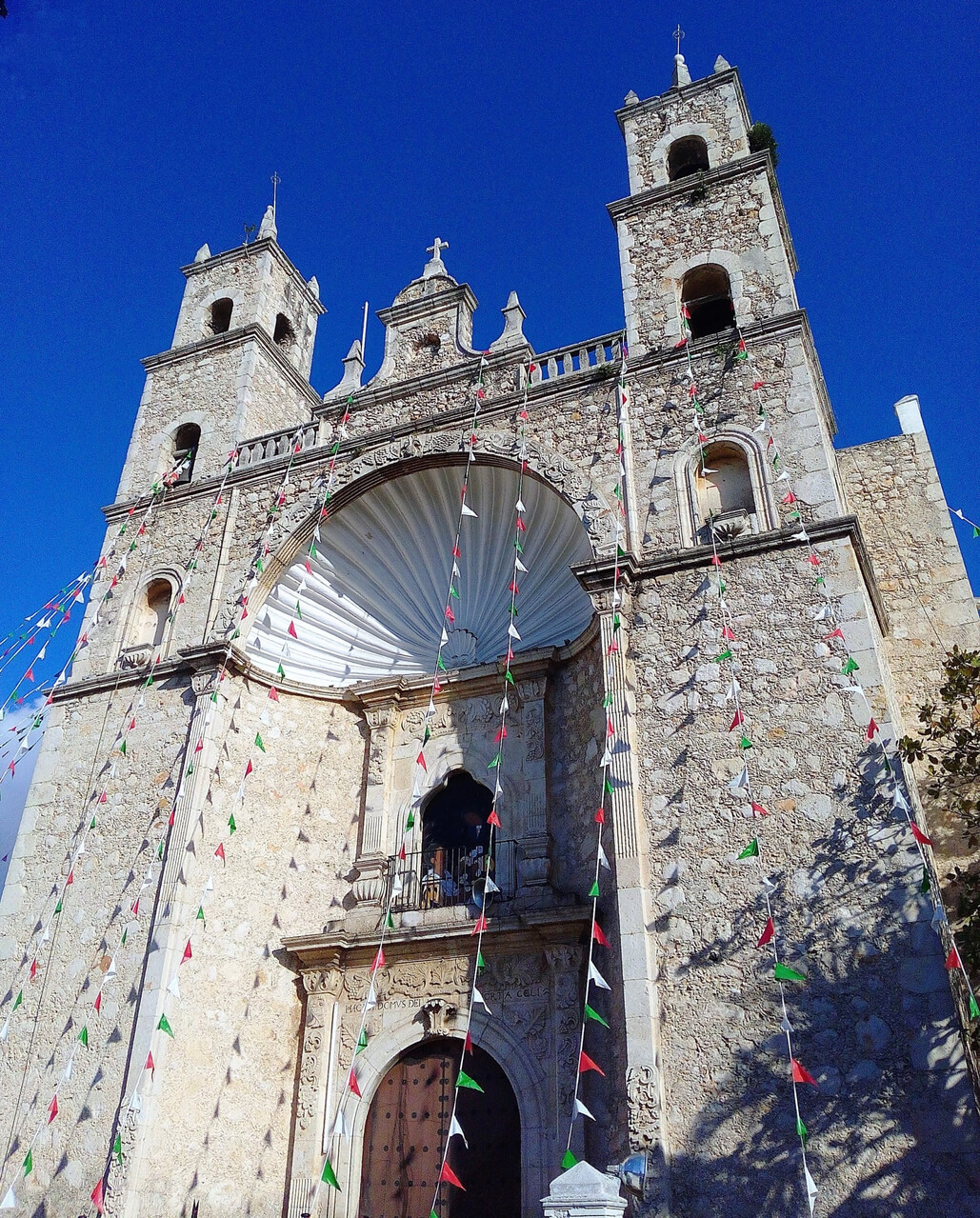
In the 1540s, Francisco Montejo and his conquistadores designated this area to house the Indigenous people from Central Mexico who had aided them in conquering the Maya.
The San Cristóbal Church, also called Our Lady of Guadalupe, was the last church built by the Spaniards in Yucatán, with its foundation stone laid in 1757.
During the city’s rapid expansion, reaching San Cristóbal was difficult due to a high hill and a steep street known as “The Street of the Impossible.” Despite this, the neighborhood became home to five distinct cultures: Maya, Mexican, Spanish, Mestizo, and Arab. Over time, Lebanese immigrants established their businesses and homes in San Cristóbal, making it a natural choice for their community.
From this culturally rich Colonia, two staples of Yucatecan cuisine emerged:
- The tortilla
- The kibi(a Lebanese-inspired dish that became a local favorite)
San Cristóbal Church – A Mérida Landmark
The church’s architecture is reminiscent of the Cathedral in Plaza Grande, featuring a recessed shell archway similar to the church in Umán. Take a moment to admire the magnificent Moorish choir window, which beautifully frames the Virgin of Guadalupe.
This church is a major landmark, not only for its architectural beauty and patron saint, but also as the site of the Virgin of Guadalupe celebrations on December 12 each year.
A stairway of 129 steps leads to the nave’s interior gallery, where a neoclassical stone retablo—reportedly sculpted by an imported European artist—can be found. The Latin inscription above the entrance reads:
“This is the House of God and the Gate of Heaven.”
Annual Event: Virgin of Guadalupe Celebration
December 12
Each year, thousands gather here to honor Our Lady of Guadalupe with festivities, processions, and religious ceremonies.